
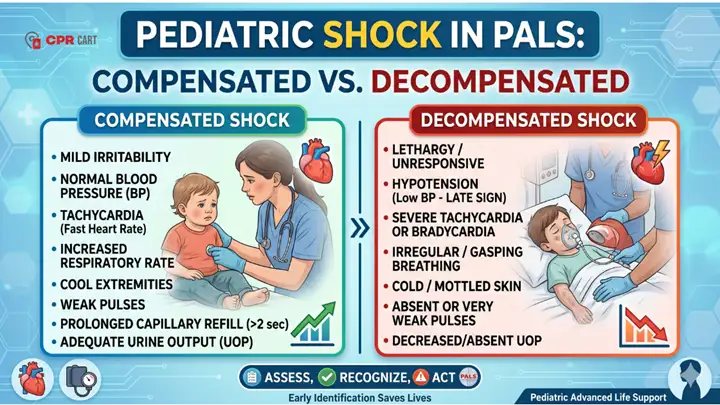
Recognizing shock early is one of the most important skills taught in Pediatric Advanced Life Support (PALS). Children do not typically deteriorate in the same way adults do. A pediatric patient may maintain a normal blood pressure despite worsening circulation and oxygen delivery. This ability to compensate can create a false impression of stability and delay treatment.
For healthcare professionals, understanding the difference between compensated and decompensated shock is essential because early recognition often determines outcomes. Waiting for hypotension can mean waiting until a child is approaching cardiovascular collapse.
This guide explains how pediatric shock progresses, what warning signs matter most, and how PALS providers assess and respond to these emergencies.
Quick Answer: Compensated vs. Decompensated Shock
Compensated shock occurs when a child maintains blood pressure through physiologic mechanisms despite poor tissue perfusion. Decompensated shock occurs when these compensatory mechanisms fail, causing hypotension and worsening circulatory collapse.
Normal blood pressure does not exclude shock in pediatric patients.
What Is Pediatric Shock?
Pediatric shock is a life-threatening condition in which the circulatory system cannot adequately deliver oxygen and nutrients to body tissues. When oxygen delivery falls, the body activates several protective responses to maintain blood flow to critical organs such as the brain and heart.
Initially, a child attempts to preserve circulation by increasing heart rate and constricting peripheral blood vessels. These mechanisms help maintain blood pressure temporarily. However, compensation has limits. As shock progresses, these protective responses begin to fail.
Pediatric shock generally moves through three stages:
- Compensated shock
- Decompensated shock
- Irreversible shock
The transition between compensated and decompensated shock is especially important because intervention during this stage can prevent progression toward cardiac arrest.
Why Pediatric Shock Is Different From Adult Shock
Children have a remarkable physiologic reserve. Their cardiovascular system can temporarily preserve blood pressure even when circulation is becoming compromised. To accomplish this, the body increases heart rate and redirects blood flow away from less essential tissues.
As peripheral blood flow decreases, skin may become pale and cool while circulation remains concentrated around the heart and brain. This process can mask early deterioration and explains why healthcare providers cannot rely on blood pressure alone.
This concept receives major emphasis during PALS education because delayed recognition of shock significantly increases risk.
“Healthcare providers enrolled in a PALS course learn to identify subtle signs of pediatric deterioration before cardiovascular collapse develops.”
Understanding Compensated Shock
Compensated shock occurs when the body is still able to preserve blood pressure despite worsening circulation. Although the child appears hemodynamically stable on paper, tissue perfusion has already started to decline.
Tachycardia is frequently the earliest measurable sign. The body attempts to improve circulation by increasing heart rate and tightening blood vessels. Reduced blood flow to the extremities often causes cool hands and feet, delayed capillary refill, and weaker peripheral pulses.
Children may also develop subtle behavioral changes. Parents frequently describe increased irritability, decreased interaction, fatigue, or unusual fussiness. Respiratory rate can rise as the body attempts to increase oxygen delivery.
Because blood pressure often remains normal, clinicians who rely solely on vital signs may overlook early shock.
Understanding Decompensated Shock
Decompensated shock develops when the body’s compensatory mechanisms can no longer sustain adequate circulation. Cardiac output declines, oxygen delivery worsens, and blood pressure begins to fall.
In pediatric patients, hypotension is generally considered a late and concerning finding. By the time blood pressure decreases, severe tissue hypoperfusion may already be present.
Mental status often deteriorates during this stage. Children may become lethargic, difficult to arouse, or less responsive. Capillary refill becomes markedly prolonged, pulses weaken, and skin may appear mottled or cyanotic. Heart rate may remain elevated initially, but severe progression can eventually result in bradycardia, which is particularly ominous in pediatric emergencies.
Bradycardia in a critically ill child often signals impending cardiac arrest and demands immediate intervention.
Is Hypotension an Early Sign of Pediatric Shock?
No. Hypotension is typically a late sign of pediatric shock. Children can maintain blood pressure despite worsening tissue perfusion through increased heart rate and vasoconstriction.
This is why providers assess the overall clinical picture rather than relying on blood pressure alone.
Compensated vs. Decompensated Shock Comparison
| Assessment Finding | Compensated Shock | Decompensated Shock |
| Blood pressure | Usually normal | Low |
| Heart rate | Elevated | Elevated or slowing |
| Mental status | Irritable or anxious | Lethargic or altered |
| Capillary refill | Delayed | Markedly delayed |
| Skin findings | Pale or cool | Mottled or cyanotic |
| Pulse quality | Weak peripheral pulses | Weak central pulses |
Common Causes of Pediatric Shock
Shock can result from several underlying conditions, and recognizing the cause helps guide treatment decisions:
- Hypovolemic shock: The most common type in children, frequently developing from dehydration associated with vomiting, diarrhea, burns, or blood loss.
- Distributive shock: Occurs when blood vessels dilate excessively, as seen in sepsis and anaphylaxis.
- Cardiogenic shock: Develops when the heart cannot pump effectively.
- Obstructive shock: Results from mechanical barriers that impair circulation (e.g., tension pneumothorax or cardiac tamponade).
Although these conditions differ in cause, all eventually reduce effective tissue perfusion if untreated.
PALS Assessment Priorities
PALS uses a structured assessment approach that emphasizes early recognition. Providers rapidly evaluate appearance, work of breathing, and circulation using the Pediatric Assessment Triangle.
- Appearance provides clues regarding neurologic status and interaction.
- Work of breathing helps identify respiratory compensation or fatigue.
- Circulation assessment focuses on skin color, perfusion, and signs of poor blood flow.
This systematic approach helps clinicians identify shock before severe physiologic collapse develops.
“Structured pediatric assessment strategies are a major component of advanced PALS training and emergency preparedness education.”
Initial Management of Pediatric Shock
Management begins with rapid assessment and stabilization. Healthcare providers first ensure airway patency and evaluate breathing. Oxygen may be administered when signs of respiratory distress or poor perfusion exist.
Prompt vascular access is essential because fluid administration and medications may be needed quickly. Depending on the underlying cause, providers may administer isotonic fluids and continuously reassess clinical response.
Mental status, pulse quality, respiratory effort, capillary refill, and urine output should be monitored repeatedly because subtle changes often reveal deterioration earlier than isolated vital signs.
Key Takeaway
Children compensate remarkably well during the early stages of shock, which makes early recognition challenging. A child with normal blood pressure can still be critically ill. PALS emphasizes identifying subtle changes such as tachycardia, delayed capillary refill, and altered appearance because these signs often appear before cardiovascular collapse.
Recognizing compensated shock before progression to decompensated shock allows earlier intervention and better outcomes in pediatric emergencies.
Frequently Asked Questions
What is compensated shock in PALS?
Compensated shock occurs when a child maintains blood pressure through increased heart rate and vascular constriction despite inadequate tissue perfusion.
What is decompensated shock?
Decompensated shock develops when the body can no longer sustain circulation, leading to hypotension and worsening tissue hypoperfusion.
Is low blood pressure an early sign of pediatric shock?
No. Hypotension is generally a late finding and often indicates severe deterioration.
What is usually the earliest sign of shock in children?
Tachycardia is commonly the earliest measurable sign of pediatric shock.
What type of shock is most common in children?
Hypovolemic shock is the most common pediatric form and is frequently associated with dehydration.