
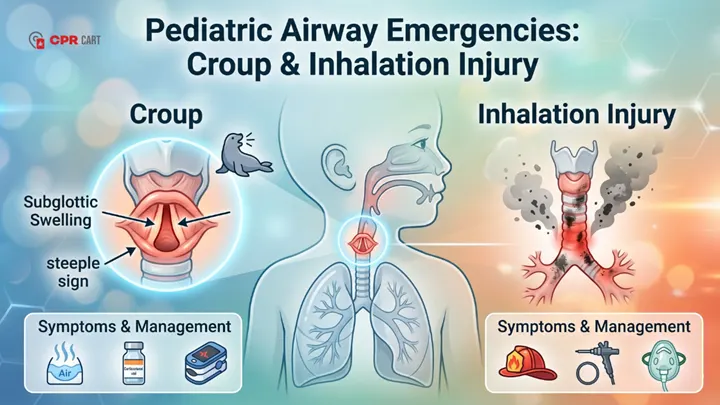
When a child cannot breathe, seconds feel like hours. In pediatric emergency medicine, airway compromise is the leading catalyst for cardiac arrest. Unlike adults, children have a significantly higher metabolic rate and oxygen demand—about 6 to 8 mL/kg per minute compared to an adult’s 3 to 4 mL/kg. Combined with a lower functional residual capacity, this means a child with a compromised airway will desaturate and deteriorate with terrifying speed.
As a healthcare provider, mastering Pediatric Advanced Life Support (PALS Certification) protocols for airway management is non-negotiable. Two of the most critical, yet clinically distinct, upper airway emergencies you will encounter are croup and inhalation injuries. This guide breaks down the pathophysiology, rapid assessment, and evidence-based interventions for both, ensuring you are prepared when every breath counts.
Quick Answer: What Are Pediatric Airway Emergencies?
Pediatric airway emergencies are conditions that impair airflow and threaten oxygen delivery. Two important examples are:
- Croup: Viral inflammation causing swelling around the upper airway and characteristic barking cough.
- Inhalation injury: Airway damage caused by smoke, heat, toxic gases, or chemical exposure.
Both conditions may initially appear mild but can deteriorate rapidly if airway obstruction worsens.
Why Pediatric Airways Are More Vulnerable
Children are not simply smaller adults. Their airway anatomy creates unique risks during respiratory emergencies.
Several features increase vulnerability:
- Smaller airway diameter
- Larger tongue relative to mouth size
- Narrow cricoid region
- Increased airway resistance
- Greater susceptibility to edema
A small amount of swelling that causes minimal issues in adults may severely compromise airflow in children.
For clinicians reviewing pediatric emergency concepts, understanding airway anatomy helps explain why early recognition matters.
“For a broader understanding of pediatric assessment and emergency response algorithms, review our complete PALS certification page.”
Understanding Croup
Croup is one of the most common pediatric upper airway emergencies. It most frequently affects children between 6 months and 3 years of age.
The condition usually develops after a viral infection causes inflammation of the larynx, trachea, and bronchi.
Common viruses include:
- Parainfluenza
- Respiratory syncytial virus (RSV)
- Influenza
- Adenovirus
Swelling develops primarily below the vocal cords, narrowing airflow and creating characteristic symptoms.
Classic Signs and Symptoms of Croup
Croup often begins with cold-like symptoms before progressing.
Typical findings include:
Barking cough
Parents often describe the sound as resembling a seal bark.
Inspiratory stridor
A harsh, high-pitched sound occurring during inhalation.
Hoarseness
Inflammation around the vocal cords alters voice quality.
Respiratory distress
Children may develop:
- Nasal flaring
- Retractions
- Tachypnea
- Agitation
Symptoms frequently worsen at night.
Severity Ranges From Mild to Critical
Not all croup cases are emergencies.
Mild cases may involve:
- Occasional barking cough
- No stridor at rest
- Minimal distress
Severe cases can include:
- Continuous stridor
- Significant work of breathing
- Cyanosis
- Fatigue
- Decreased responsiveness
Late findings may indicate impending respiratory failure.
Initial Assessment Priorities in Suspected Croup
Healthcare providers should focus on overall respiratory status rather than immediately agitating the child.
Assessment should include:
Airway patency, breathing effort, oxygenation, mental status, and skin color.
Children with upper airway obstruction often worsen when frightened. Excessive stimulation can increase distress and airflow obstruction.
Observe before intervening aggressively.
Treatment Considerations for Croup
Management varies depending on severity.
Common interventions include:
Humidified oxygen when indicated, corticosteroids, nebulized epinephrine for moderate-to-severe symptoms, and ongoing observation.
Severe airway compromise may require escalation of care.
Because pediatric respiratory emergencies can evolve rapidly, providers should understand how airway compromise progresses during pediatric resuscitation scenarios.
Understanding Pediatric Inhalation Injury
Inhalation injury occurs when heat, smoke, chemicals, or toxic combustion products damage the airway or lungs.
Children involved in house fires or enclosed-space smoke exposure face increased risk because of their airway size and higher respiratory rates.
Unlike croup, inhalation injuries can involve multiple mechanisms simultaneously:
- Thermal injury
- Chemical irritation
- Carbon monoxide exposure
- Toxic gas exposure
- Lower airway injury
Initial symptoms may seem minimal despite severe evolving damage.
Common Causes of Pediatric Inhalation Injury
Several scenarios increase concern:
House fires, chemical accidents, smoke exposure, burns in enclosed environments, and toxic fume exposure.
Children trapped in enclosed areas often sustain greater injury due to prolonged exposure.
Warning Signs of Inhalation Injury
Providers should maintain a high level of suspicion.
Concerning findings include:
Facial burns
Burns around the mouth or face may indicate airway exposure.
Singed nasal hair
Heat exposure can damage upper airway structures.
Soot around mouth or nose
Visible soot suggests smoke inhalation.
Hoarseness
Voice changes may indicate airway edema.
Stridor
Progressive swelling can obstruct airflow.
Wheezing
Lower airway involvement may create bronchospasm.
Altered mental status
Possible indication of hypoxia or toxic gas exposure.
Why Inhalation Injuries Can Be Deceptive
One of the greatest challenges with inhalation injury is delayed progression.
Airway swelling often worsens over time.
A child appearing stable initially may later develop:
- Increasing respiratory effort
- Stridor
- Hypoxemia
- Airway obstruction
Close monitoring is critical.
Assessment Priorities During Suspected Inhalation Injury
Healthcare providers should evaluate:
Airway status, breathing quality, circulation, burn severity, oxygenation, and exposure history.
Questions include:
- Was the injury in an enclosed area?
- Was smoke exposure prolonged?
- Were chemicals involved?
- Was there loss of consciousness?
History often provides important clues.
Comparing Croup vs Inhalation Injury
Although both conditions affect the airway, they differ substantially.
| Feature | Croup | Inhalation Injury |
| Cause | Viral inflammation | Smoke, heat, chemicals |
| Typical onset | Gradual | Sudden or delayed |
| Barking cough | Common | Rare |
| Facial burns | No | Possible |
| Soot exposure | No | Common |
| Stridor | Common | Possible |
| Progression | Hours to days | May worsen rapidly |
Recognizing distinctions can improve early clinical decision-making.
Pediatric Airway Emergencies and PALS Concepts
PALS emphasizes early identification of respiratory compromise before cardiac arrest develops.
Providers are taught to recognize:
- Respiratory distress
- Respiratory failure
- Shock
- Altered mental status
- Progressive airway compromise
Educational content like this supports understanding, while comprehensive certification courses provide structured training and skills evaluation.
Final Thoughts
Pediatric airway emergencies demand early recognition and careful observation. Conditions such as croup and inhalation injuries may begin with subtle symptoms yet progress rapidly because of the unique anatomy of a child’s airway.
Healthcare providers who understand common warning signs and assessment priorities can identify deterioration earlier and initiate appropriate interventions. Educational articles support foundational learning, but complete pediatric emergency preparation requires structured training and hands-on experience.
To deepen your clinical expertise and ensure you are ready for any pediatric emergency, explore our comprehensive PALS Certification and Recertification courses designed for modern healthcare professionals.
Frequently Asked Questions
What is the difference between croup and inhalation injury?
Croup is a viral illness causing upper airway swelling and a barking cough. Inhalation injury results from smoke, heat, or chemical exposure that damages the airway and lungs.
Can croup become life-threatening?
Yes. Most cases are mild, but severe croup can cause significant airway obstruction and respiratory distress requiring emergency treatment.
Why are inhalation injuries dangerous in children?
Children have smaller airways and higher respiratory rates. Swelling after smoke exposure can rapidly reduce airflow and worsen breathing.
What are early warning signs of airway obstruction in children?
Signs include stridor, retractions, nasal flaring, increased breathing effort, cyanosis, and changes in mental status.
Does every child with smoke exposure develop inhalation injury?
No. However, symptoms may be delayed. Any child exposed to smoke in an enclosed environment should receive careful evaluation.
How does PALS address pediatric respiratory emergencies?
PALS teaches structured assessment methods and management strategies for recognizing respiratory distress, airway compromise, and pediatric emergencies before deterioration occurs.