
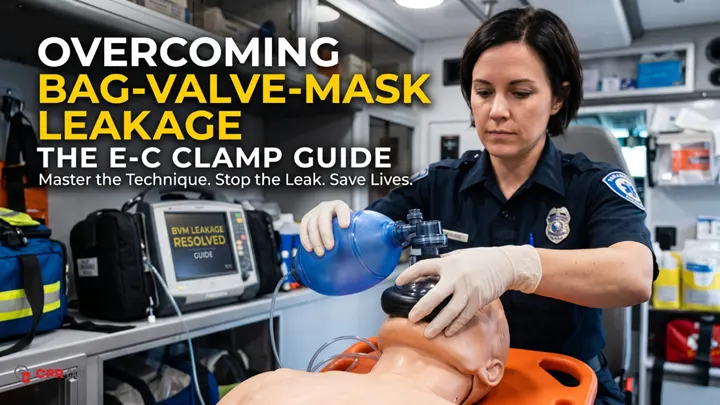
Bag-valve-mask (BVM) ventilation is one of the most important skills in emergency response and one of the most commonly performed incorrectly. During a BLS skills check, many students understand compression sequences and AED use but struggle when it comes to maintaining a proper mask seal.
A leaking mask means oxygen escapes instead of reaching the patient’s lungs. In a real emergency, this can reduce ventilation effectiveness. During certification testing, poor BVM technique can also affect performance evaluations.
The good news: most leakage problems can be corrected by mastering one fundamental skill—the E-C clamp hand position.
This guide explains how the E-C clamp works, why leakage occurs, and how healthcare providers can improve ventilation success during BLS practice and patient care.
Quick Answer: What Is the E-C Clamp Technique?
The E-C clamp technique is a hand position used during bag-valve-mask ventilation where:
- Thumb and index finger form a “C” shape around the mask
- Remaining three fingers create an “E” shape along the jaw
- Fingers lift the jaw upward while maintaining a tight mask seal
The technique serves two purposes simultaneously:
- Creates an airtight seal around the face
- Opens the airway through jaw lift
Without both actions happening together, air leakage becomes more likely.
This dual purpose makes the E-C clamp one of the most important BLS airway skills to master.
Why Bag-Valve-Mask Leakage Happens
Many students assume mask leaks occur because they are squeezing the bag incorrectly.
Most leaks actually occur because of poor mask positioning or hand placement.
Common causes include:
1. Insufficient Jaw Lift
Many rescuers press downward into the face instead of lifting the jaw upward.
This creates:
- Air escape around mask edges
- Poor airway alignment
- Reduced chest rise
- Less effective ventilation
Remember:
The goal is not pressing the mask harder.
The goal is lifting the patient’s jaw into the mask.
2. Incorrect Finger Positioning
Small hand placement errors can dramatically affect seal quality.
Common examples:
- Fingers placed on soft tissue beneath chin
- Hands too low on jaw
- Thumb not centered on mask
- Uneven pressure distribution
These mistakes frequently create gaps where oxygen escapes.
3. Wrong Mask Size
Even excellent technique struggles when mask size is incorrect.
A mask that is:
Too large:
- Extends into eyes
- Creates gaps near cheeks
Too small:
- Does not fully cover mouth and nose
- Causes seal instability
Proper sizing matters before ventilation even begins.
4. Facial Anatomy Challenges
Some patients naturally present difficult ventilation scenarios.
Examples include:
- Beards
- Facial trauma
- Missing teeth
- Obesity
- Excess facial tissue
These situations often require additional modifications or a second rescuer.
How to Perform the E-C Clamp Correctly
Follow these steps:
Step 1: Position the Mask
Place the mask over:
- Nose
- Mouth
- Chin
The narrow portion sits over the nose.
The wider portion rests over the chin.
Step 2: Form the “C”
Use:
- Thumb
- Index finger
These fingers create a “C” around the top of the mask.
Apply even pressure around mask borders.
Avoid excessive force.
Step 3: Form the “E”
The remaining fingers create the “E.”
Place:
- Middle finger
- Ring finger
- Pinky
Along the lower jaw.
Lift upward.
Do not push into neck tissue.
Step 4: Lift the Jaw
This step is often missed.
Use fingers to:
- Pull jaw upward
- Maintain airway position
- Keep seal stable
Jaw lift, not downward pressure is what prevents leaks.
Step 5: Deliver Ventilations
Squeeze slowly.
Watch for:
- Visible chest rise
- Smooth expansion
- No audible leakage
Avoid forceful breaths.
Excessive ventilation can create complications.
Signs Your Bag-Valve-Mask Seal Is Leaking
Recognizing a poor seal quickly can prevent repeated ineffective breaths.
Look for:
- Audible hissing sounds
- Poor chest rise
- Air escaping near eyes
- Mask movement
- Resistance changes
- Inadequate ventilation volume
If these appear:
Pause and reassess hand placement.
One-Rescuer vs Two-Rescuer BVM Ventilation
Research and training experience consistently show improved ventilation success with two rescuers.
One-Rescuer Technique
One person:
- Maintains mask seal
- Opens airway
- Squeezes bag
This can be difficult, especially for providers with smaller hands.
Two-Rescuer Technique
One rescuer:
- Uses both hands for mask seal
Second rescuer:
- Squeezes ventilation bag
Advantages:
- Better seal
- Less leakage
- Improved tidal volume delivery
- Reduced fatigue
Healthcare providers frequently use two-person BVM whenever available.
Why BVM Practice Matters in BLS Training
Many learners focus heavily on chest compressions.
Airway skills receive less attention.
Yet ventilation failures commonly occur because providers:
- Rarely practice mask seals
- Do not receive feedback
- Rush through airway stations
High-quality skills sessions should include repeated hands-on BVM practice.
For students preparing for certification or renewal, practical airway repetition often improves confidence more than reading algorithms.
Related: How Chest Recoil Errors Can Cause BLS Skills Check Failures
Final Thoughts
Bag-valve-mask ventilation often looks easy until providers perform it under pressure.
Small hand positioning errors can create major oxygen delivery problems. The E-C clamp remains one of the most valuable airway skills because it combines mask sealing with airway opening in one movement.
Whether preparing for a BLS skills check or caring for a patient in an emergency, mastering this technique can improve ventilation quality and build confidence when seconds matter.
Need hands-on practice? Explore our AHA BLS Certification and Renewal options with quick skills sessions and same-day cards.
Frequently Asked Questions
What causes bag-valve-mask leakage?
Bag-valve-mask leakage usually occurs because of poor mask seal technique, inadequate jaw lift, incorrect hand positioning, wrong mask size, or difficult facial anatomy.
What does the E-C clamp do during BVM ventilation?
The E-C clamp creates an airtight seal while simultaneously lifting the jaw to maintain an open airway.
Is one-person BVM ventilation difficult?
Yes. One-person bag-valve-mask ventilation can be challenging because the rescuer must maintain the seal, open the airway, and squeeze the bag simultaneously.
Why is jaw lift important during BVM use?
Jaw lift helps align the airway and brings the patient’s face into the mask seal. Pressing downward often worsens leakage.
How do I know if BVM ventilation is effective?
Effective BVM ventilation usually produces visible chest rise without excessive resistance or audible air leakage.