
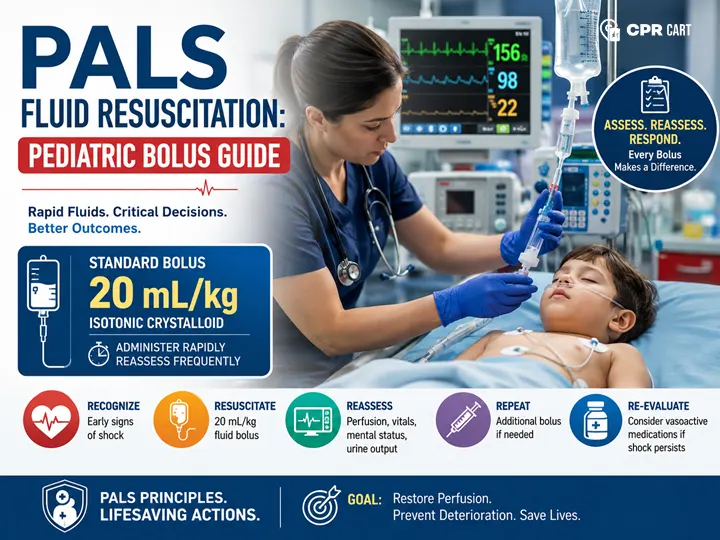
Rapid recognition and treatment of pediatric shock are among the most critical skills taught in Pediatric Advanced Life Support (PALS). Children often maintain their blood pressure until the late stages of shock, making early intervention essential. One of the most effective treatments for restoring circulation and tissue perfusion is timely fluid resuscitation.
Understanding when to administer fluids, how much to give, and how to evaluate a child’s response can significantly improve outcomes during pediatric emergencies. Whether shock results from dehydration, sepsis, trauma, or other causes, healthcare providers must be prepared to deliver fluid therapy safely and effectively.
This comprehensive PALS fluid resuscitation guide explains pediatric bolus dosing, administration techniques, reassessment strategies, and special considerations based on current PALS principles.
What Is Fluid Resuscitation in PALS?
Fluid resuscitation is the rapid administration of intravenous (IV) or intraosseous (IO) fluids to restore circulating blood volume and improve tissue perfusion in children experiencing shock.
The primary goals of pediatric fluid resuscitation are to:
- Restore intravascular volume
- Improve cardiac output
- Enhance oxygen delivery to tissues
- Correct hypotension and poor perfusion
- Prevent progression to cardiopulmonary arrest
Fluid therapy is often one of the first interventions performed after airway and breathing stabilization during pediatric shock management.
PALS fluid resuscitation typically begins with a rapid isotonic crystalloid bolus of 20 mL/kg administered over 5–20 minutes, followed by reassessment of perfusion, heart rate, blood pressure, mental status, and urine output. Additional boluses may be given depending on the child’s response and the underlying cause of shock.
Why Children Require Early Fluid Resuscitation
Children differ from adults in their physiological response to shock. Pediatric patients can compensate for significant circulatory compromise through:
- Increased heart rate
- Increased systemic vascular resistance
- Redistribution of blood flow to vital organs
Because of these compensatory mechanisms, blood pressure may remain normal until shock becomes severe. Waiting for hypotension before initiating treatment can delay lifesaving interventions.
For this reason, PALS emphasizes identifying early signs of compensated shock and beginning treatment before decompensation occurs.
Related reading: PALS Shock: Early Signs of Decompensated Shock
When Is a Pediatric Fluid Bolus Indicated?
Fluid bolus therapy is commonly indicated when a child shows signs of inadequate tissue perfusion. Common causes include:
Hypovolemic Shock
The most frequent type of pediatric shock.
Causes include:
- Severe dehydration
- Gastroenteritis
- Excessive vomiting
- Diarrhea
- Hemorrhage
- Burns
Children with hypovolemic shock often respond well to aggressive fluid replacement.
Septic Shock
Severe infection can cause vasodilation, capillary leak, and intravascular volume depletion. Early fluid administration is a cornerstone of pediatric sepsis treatment.
Distributive Shock
Conditions causing abnormal vascular tone may require fluid support in addition to vasoactive medications.
Trauma-Related Shock
Fluid therapy may be used initially while hemorrhage control and blood product administration are arranged.
Standard PALS Fluid Bolus Dose
The recommended initial fluid bolus in most pediatric shock situations is: 20 mL/kg of Isotonic Crystalloid
Common fluids include:
- Normal Saline (0.9% Sodium Chloride)
- Lactated Ringer’s Solution
The bolus should generally be administered over:
- 5–20 minutes for significant shock
- Faster administration for severe circulatory compromise
After each bolus, the patient must be reassessed before additional fluid administration.
Quick Reference Table
| Weight | 20 mL/kg Bolus |
| 5 kg | 100 mL |
| 10 kg | 200 mL |
| 15 kg | 300 mL |
| 20 kg | 400 mL |
| 25 kg | 500 mL |
| 30 kg | 600 mL |
Which Fluids Are Recommended in PALS?
PALS recommends isotonic crystalloids as first-line therapy for most pediatric shock states.
Normal Saline (0.9% Sodium Chloride)
Advantages:
- Widely available
- Compatible with most emergency medications
- Effective intravascular volume expansion
Lactated Ringer’s Solution
Advantages:
- Balanced electrolyte composition
- May reduce risk of hyperchloremic metabolic acidosis
- Frequently used in trauma and surgical settings
Both fluids are considered acceptable initial choices.
How to Administer a Pediatric Fluid Bolus
Rapid fluid delivery is essential when treating shock.
Step 1: Establish Vascular Access
Preferred options include:
- Peripheral IV access
- Intraosseous (IO) access when IV access is delayed
PALS emphasizes obtaining IO access quickly if IV placement is unsuccessful during emergencies.
Step 2: Use Pressure-Assisted Delivery
Rapid administration may require:
- Pressure bags
- Syringe push-pull technique
- Infusion pumps programmed for bolus delivery
Step 3: Deliver the Bolus
Administer the prescribed volume as rapidly as clinically indicated.
Step 4: Reassess Immediately
Every fluid bolus should be followed by a structured reassessment.
How to Evaluate Response to Fluid Resuscitation
Clinical reassessment determines whether additional fluids are needed.
Positive indicators include:
- Improved mental status
- Decreasing heart rate
- Stronger peripheral pulses
- Improved capillary refill
- Increased urine output
- Improved skin color and temperature
- Improved blood pressure
Persistent signs of poor perfusion may indicate ongoing shock requiring additional intervention.
How Many Fluid Boluses Can Be Given?
The answer depends on the underlying cause of shock and the child’s response. Historically, children with hypovolemic shock often received repeated boluses totaling up to 40–60 mL/kg or more when clinically appropriate.
Modern PALS practice emphasizes:
- Frequent reassessment
- Individualized treatment
- Avoidance of fluid overload
- Early consideration of vasoactive medications when shock persists
Providers should continuously evaluate whether additional fluids remain beneficial.
Signs of Fluid Overload
Excessive fluid administration can worsen outcomes, particularly in septic shock and children with cardiac dysfunction.
Watch for:
- Hepatomegaly
- Pulmonary crackles
- Increased work of breathing
- New oxygen requirement
- Pulmonary edema
- Worsening respiratory distress
If these signs develop, fluid administration should be reconsidered and vasoactive support may become necessary.
Special Considerations for Septic Shock
Pediatric septic shock requires careful balancing of rapid resuscitation with avoidance of fluid overload.
Current practice emphasizes:
- Early recognition
- Timely isotonic fluid administration
- Frequent reassessment after each bolus
- Monitoring for signs of fluid accumulation
- Early vasoactive support when indicated
Children with septic shock who fail to improve after initial fluid resuscitation may require medications such as epinephrine or norepinephrine.
Fluid Resuscitation in Trauma Patients
Children with traumatic injuries require special consideration.
While initial crystalloid boluses may be appropriate, significant hemorrhage often requires:
- Blood products
- Hemorrhage control
- Massive transfusion protocols
Repeated large-volume crystalloid administration may worsen dilutional coagulopathy and should not delay definitive treatment.
When to Use Intraosseous Access
Intraosseous access is one of the most important skills in pediatric resuscitation.
PALS recommends IO placement when:
- IV access cannot be rapidly obtained
- The child is critically ill
- Shock is progressing
- Medications or fluids must be administered immediately
IO access allows administration of:
- Fluids
- Blood products
- Epinephrine
- Other emergency medications
Fluid delivery through IO access is considered equivalent to IV administration during resuscitation.
Common Pediatric Fluid Resuscitation Mistakes
Several errors can delay shock reversal.
These include:
- Waiting for hypotension before treating shock
- Delayed vascular access
- Slow fluid administration
- Failure to reassess after boluses
- Missing signs of fluid overload
- Delaying vasoactive medications when fluids are ineffective
Recognition and avoidance of these mistakes improve patient outcomes.
Key PALS Fluid Resuscitation Takeaways
Pediatric shock is a time-sensitive emergency requiring rapid intervention. The standard initial PALS fluid bolus is 20 mL/kg of isotonic crystalloid delivered over 5–20 minutes, followed by immediate reassessment.
Successful fluid resuscitation depends not only on administering fluids quickly but also on continuously evaluating the child’s response and recognizing when additional therapies are needed. Early identification of shock, rapid vascular access, appropriate bolus dosing, and vigilant reassessment remain fundamental principles of pediatric resuscitation.
Get PALS Certified: Ensure your resuscitation skills are fully up to date with modern clinical protocols.
Frequently Asked Questions
What is the standard pediatric fluid bolus in PALS?
The standard initial PALS fluid bolus is 20 mL/kg of isotonic crystalloid solution such as normal saline or lactated Ringer’s administered rapidly with reassessment after each bolus.
How fast should a pediatric fluid bolus be given?
In children with shock, fluid boluses are generally administered over 5–20 minutes depending on the severity of illness and clinical condition.
What fluid is preferred for pediatric shock?
Isotonic crystalloids, including normal saline and lactated Ringer’s solution, are recommended first-line fluids for most pediatric shock states.
How do you know if a child is responding to fluid resuscitation?
Improvement in mental status, heart rate, capillary refill, pulse quality, blood pressure, skin perfusion, and urine output suggests a positive response.
When should intraosseous access be used?
IO access should be established when IV access cannot be obtained rapidly in a critically ill child who requires immediate fluids or medications.
Can too much fluid be harmful in pediatric shock?
Yes. Excessive fluid administration can lead to pulmonary edema, respiratory distress, and worsening outcomes. Frequent reassessment is essential.
What are the earliest signs of pediatric shock?
Tachycardia, delayed capillary refill, weak peripheral pulses, cool extremities, altered mental status, and decreased urine output are common early indicators.
What is the PALS fluid bolus dose?
The standard PALS fluid bolus is 20 mL/kg of isotonic crystalloid solution, such as normal saline or lactated Ringer’s, administered rapidly and followed by reassessment.
When should a pediatric fluid bolus be given?
A pediatric fluid bolus is indicated when a child shows signs of shock, including tachycardia, delayed capillary refill, weak pulses, altered mental status, or hypotension.