
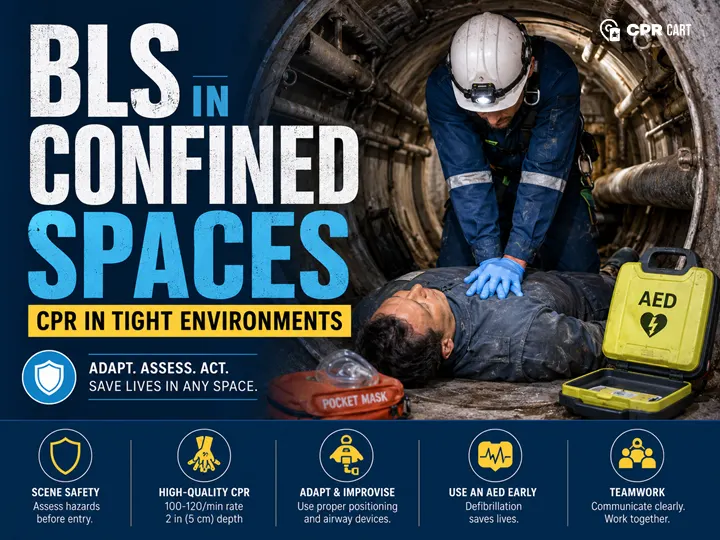
BLS in confined spaces refers to performing Basic Life Support (BLS) and CPR when a cardiac arrest victim is located in an area with limited access, restricted movement, or environmental hazards that make standard resuscitation difficult. Rescuers must adapt CPR techniques while maintaining high-quality compressions, effective ventilation, and scene safety.
Performing Basic Life Support is challenging under ideal conditions, but when a cardiac arrest occurs in a tight environment, the difficulty increases significantly. Rescuers may have limited room to position themselves, deploy equipment, or coordinate with other responders. Whether the emergency occurs in an elevator, vehicle, crawl space, utility vault, or industrial tank, lifesaving care often depends on adapting standard CPR techniques to fit the environment.
This guide explains how CPR is adapted in tight environments, when a victim should be moved before resuscitation begins, how rescuers can maintain effective BLS despite space limitations, and what equipment and safety considerations are most important during a confined-space emergency.
What Does CPR in a Confined Space Mean?
CPR in a confined space means performing lifesaving chest compressions and ventilations in an environment where limited access, restricted movement, or safety hazards make standard resuscitation more difficult.
Unlike a typical emergency occurring in an open room, confined-space incidents force rescuers to adapt quickly. The victim may be trapped in a location where kneeling beside the chest is impossible, airway access is limited, or emergency equipment cannot be positioned normally.
Examples include:
- Industrial tanks
- Utility vaults
- Storage silos
- Crawl spaces
- Attics
- Elevators
- Trenches
- Vehicle interiors
- Machinery compartments
- Underground tunnels
For BLS providers, the primary challenge is maintaining high-quality CPR despite environmental limitations.
Related: BLS Certification
What Are the Challenges of CPR in Confined Spaces?
The biggest challenges include limited movement, difficult patient access, rescuer fatigue, environmental hazards, and communication barriers among rescue team members.
While CPR principles remain the same, the environment often makes them harder to execute effectively.
Limited Body Positioning
Standard CPR is designed for a rescuer kneeling beside the victim with shoulders positioned directly over the sternum.
In confined spaces, rescuers may need to:
- Kneel awkwardly
- Lean across obstacles
- Compress from unusual angles
- Work in cramped positions
These limitations can reduce compression effectiveness and increase fatigue.
Restricted Access to the Victim
Victims may be pinned against walls, trapped inside machinery, or located in narrow spaces.
Restricted access can make it difficult to:
- Assess breathing
- Check a pulse
- Open the airway
- Deliver rescue breaths
- Attach AED pads
Environmental Hazards
Some confined spaces contain hazards that threaten rescuers as well as victims.
Potential dangers include:
- Oxygen-deficient atmospheres
- Toxic gases
- Chemical exposure
- Fire hazards
- Extreme temperatures
- Electrical hazards
Rescuers should never enter a dangerous environment without proper training and protective equipment.
Communication Challenges
Noise, distance, poor visibility, and structural barriers can complicate communication.
Without clear communication, rescuers may struggle to coordinate compressions, ventilations, AED use, and patient movement.
Can High-Quality CPR Be Performed in a Confined Space?
Yes. High-quality CPR can still be effective in a confined space if rescuers maintain proper compression depth, rate, recoil, and minimize interruptions.
The challenge is not the CPR technique itself but the physical limitations imposed by the environment. Rescuers may need to modify their body position, switch compressors more frequently due to fatigue, or relocate the victim when safe to do so.
Regardless of the setting, current BLS guidelines continue to prioritize:
- Compression rate of 100–120 per minute
- Compression depth of at least 2 inches (5 cm) in adults
- Full chest recoil
- Minimal interruptions
- Early AED use
Even in difficult environments, maintaining these core principles provides the victim with the best chance of survival.
Related: High-Quality CPR Guidelines
How Do You Perform CPR in a Tight Space?
Perform CPR in a tight space by following standard BLS priorities while adapting positioning, equipment placement, and team coordination to maintain effective chest compressions and ventilations.
Step 1: Ensure Scene Safety
Before approaching the victim:
- Assess environmental hazards.
- Determine whether the area is safe to enter.
- Use appropriate personal protective equipment.
- Request specialized rescue assistance if necessary.
Scene safety always takes priority over patient care.
Step 2: Check Responsiveness
Tap the victim and shout to determine responsiveness.
If the person is unresponsive:
- Activate emergency medical services.
- Send someone to retrieve an AED.
- Begin immediate assessment.
Step 3: Check Breathing and Pulse
Healthcare providers should check:
- Normal breathing
- Carotid pulse
Complete the assessment within 10 seconds.
If there is no pulse and breathing is absent or abnormal, begin CPR immediately.
Step 4: Position Yourself for Effective Compressions
When possible:
- Place the victim on a firm surface.
- Position yourself directly over the center of the chest.
- Lock your elbows.
- Use your body weight to generate compressions.
If space limitations prevent standard positioning, adapt your approach while maintaining adequate compression depth and full chest recoil. In narrow hallways, trenches, crawl spaces, or similar environments, rescuers may perform over-the-head CPR from behind the victim’s head. In extremely tight locations, a straddle position over the victim’s hips or torso may provide better leverage than kneeling beside the patient.
Regardless of positioning, the goal remains the same: deliver compressions at a rate of 100–120 per minute with minimal interruptions.
Step 5: Deliver High-Quality Chest Compressions
Follow standard adult BLS recommendations:
- Compression rate: 100–120 per minute
- Compression depth: at least 2 inches (5 cm)
- Full chest recoil after each compression
- Minimal interruptions
If fatigue develops quickly because of awkward positioning, switch compressors whenever possible.
Step 6: Provide Effective Ventilations
Use the most practical airway device available.
Options include:
- Pocket mask
- Mouth-to-mask ventilation
- Bag-valve mask (BVM)
Avoid excessive ventilation, which can reduce CPR effectiveness.
Step 7: Apply an AED as Soon as Possible
Early defibrillation remains one of the most important interventions during cardiac arrest.
When an AED arrives:
- Expose the chest
- Apply pads correctly
- Follow voice prompts
- Minimize interruptions during rhythm analysis and shock delivery
Related: AED Use During Cardiac Arrest
Should You Move the Victim Before Starting CPR?
Move the victim only when the environment is unsafe or when effective CPR cannot be performed in the current location.
In most situations, immediate CPR is preferable to delaying care while moving the patient.
However, relocation may be necessary when:
- There is insufficient room for compressions.
- Toxic substances are present.
- Fire or explosion risks exist.
- Structural collapse is possible.
- Electrical hazards remain active.
Situations Where Immediate Movement Is Appropriate
Examples include:
- Vehicle fires
- Hazardous chemical leaks
- Oxygen-deficient confined spaces
- Active electrical hazards
- Dangerous machinery environments
When movement is necessary, rescuers should minimize interruptions in CPR whenever possible.
One-Rescuer vs. Two-Rescuer CPR in Confined Spaces
One-Rescuer CPR
Onerescuer CPR in a confined space is physically demanding because the rescuer must manage every aspect of care alone.
The rescuer must:
- Perform compressions
- Manage the airway
- Provide ventilations
- Retrieve and operate an AED when available
Because awkward body positioning often accelerates fatigue, compression quality may decline more quickly than in open environments.
Two-Rescuer CPR
Two-rescuer CPR is the preferred approach whenever sufficient personnel are available.
One rescuer can focus on:
- Chest compressions
The second rescuer can manage:
- Airway support
- Ventilations
- AED operation
- Communication with emergency services
This division of responsibilities helps maintain higher-quality CPR.
What Equipment Works Best for CPR in Confined Spaces?
Portable and compact equipment is often easier to deploy effectively in restricted environments than larger resuscitation devices.
Pocket Masks
Pocket masks are valuable because they:
- Improve infection control
- Provide better ventilation than mouth-to-mouth breathing
- Fit easily into emergency response kits
Bag-Valve Masks
Bag-valve masks provide effective ventilations but may be difficult to operate in very confined areas.
When possible, two trained rescuers should work together when using a BVM.
Automated External Defibrillators
AEDs remain a critical component of confined-space cardiac arrest care.
Responders should ensure:
- Proper pad placement
- Safe shock delivery
- Minimal interruption of chest compressions
Personal Protective Equipment
Depending on the environment, rescuers may require:
- Gloves
- Eye protection
- Respiratory protection
- Hard hats
- Safety harnesses
Appropriate PPE protects rescuers while allowing patient care to continue safely.
Real-World Examples of CPR in Tight Environments
CPR in an Elevator
Elevators often provide limited room for movement and equipment placement.
If the victim cannot be moved safely without delaying care, CPR should begin immediately inside the elevator while additional help is summoned.
CPR Inside a Vehicle
Cardiac arrest may occur inside:
- Cars
- Trucks
- Buses
- Construction vehicles
When feasible, move the victim to a flat surface outside the vehicle before starting CPR. If immediate movement is impossible, begin lifesaving care without delay.
CPR in Industrial Tanks and Utility Vaults
These environments often present the highest risk because they may contain atmospheric hazards.
Untrained rescuers should never enter these spaces without appropriate confined-space rescue procedures.
CPR in Crawl Spaces and Attics
Crawl spaces and attics frequently limit body positioning.
Rescuers may need to use over-the-head CPR or other modified positions while maintaining compression quality.
How Do Rescue Teams Coordinate CPR in Confined Spaces?
Effective team coordination improves both rescuer safety and patient outcomes during confined-space emergencies.
Successful rescue teams often assign specific responsibilities before entering the environment.
Common roles include:
- Compressor
- Airway manager
- AED operator
- Team leader
- Safety officer
Clear communication helps reduce delays, avoid duplication of tasks, and maintain continuous patient care.
In industrial settings, routine rescue drills improve coordination and preparedness for real emergencies.
Legal and Safety Considerations for Rescuers
Rescuers should never place themselves in serious danger while attempting to provide CPR.
Good Samaritan laws often protect individuals who provide reasonable emergency care in good faith, but legal protections vary by location.
Important safety principles include:
- Do not enter hazardous confined spaces without proper training.
- Follow workplace rescue procedures.
- Use required protective equipment.
- Activate emergency services immediately.
- Stay within your level of training.
An injured rescuer creates a second emergency and may delay lifesaving care for the victim.
Key Takeaways
BLS in confined spaces requires flexibility, situational awareness, and a strong understanding of high-quality CPR principles. Although restricted movement, difficult access, and environmental hazards can complicate resuscitation efforts, the priorities remain unchanged: ensure scene safety, begin CPR quickly, provide effective chest compressions, use an AED as soon as possible, and minimize interruptions.
Whether responding to a cardiac arrest in a vehicle, elevator, crawl space, trench, or industrial facility, rescuers who understand confined-space CPR adaptations can improve survival outcomes while protecting themselves from unnecessary risk.
Frequently Asked Questions
What is confined-space CPR?
Confined-space CPR is CPR performed in an area with limited access, restricted movement, or environmental hazards that make standard resuscitation more difficult.
Should CPR start immediately in a confined space?
Yes, if the scene is safe. Begin CPR immediately unless environmental hazards threaten rescuers or the victim must be moved to allow effective chest compressions.
Can an AED be used in a confined space?
Yes. An AED should be applied as soon as it becomes available, provided there is enough access to place the pads safely and follow the device prompts.
What is the biggest challenge of CPR in tight environments?
Maintaining high-quality chest compressions is the biggest challenge because restricted space can limit rescuer positioning and increase fatigue.
Should a victim be moved before CPR begins?
Usually no. Start CPR immediately unless hazards are present or there is insufficient room to deliver effective chest compressions.
Is two-rescuer CPR better in confined spaces?
Yes. Two rescuers can share responsibilities, reduce fatigue, maintain compression quality, and manage airway and AED tasks more effectively.
Is over-the-head CPR effective?
Yes. Over-the-head CPR can be an effective alternative when access to the victim’s side is restricted, provided compression depth, rate, and recoil remain adequate.
Is it safe to enter a confined space to perform CPR?
Only if the environment is safe. Rescuers should never enter areas containing toxic gases, oxygen deficiencies, electrical hazards, or other serious dangers without proper training and equipment.
What equipment is most useful for confined-space CPR?
Pocket masks, AEDs, gloves, and other portable emergency response equipment are often the most practical tools in restricted environments.