

Healthcare professionals rarely have unlimited time for certification. A travel nurse receives a new assignment with little notice. A hospital onboarding department requests updated credentials. A provider suddenly notices an expired certification card before an upcoming shift.
When deadlines become tight, many healthcare workers ask:
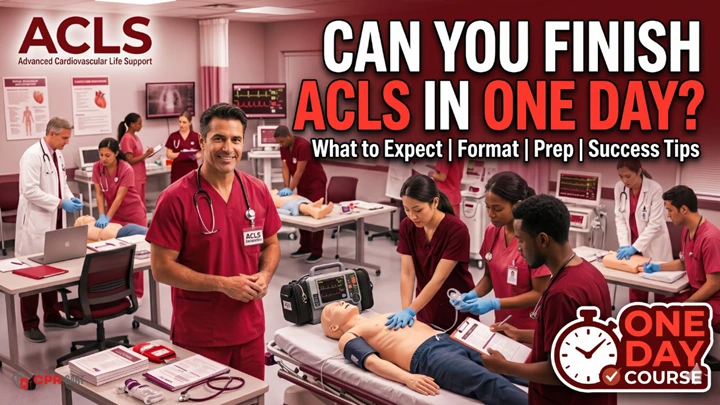
Can you finish ACLS in one day?
The short answer is:
Yes, many healthcare providers can complete ACLS within a single day depending on course structure, scheduling availability, prior experience, and preparation.
However, not everyone finishes at the same pace. Completion time varies based on how the course is delivered and how quickly learners progress through required material.
This guide explains what affects ACLS completion time, who can realistically finish in one day, and how modern training formats help healthcare providers complete certification more efficiently.
Quick Answer: Can You Finish ACLS in One Day?
Yes. Many healthcare professionals complete ACLS within a single day, especially when courses use flexible blended learning formats.
For many learners, the process typically involves:
- Completing online coursework
- Finishing required assessments
- Attending a hands-on skills evaluation
- Successfully demonstrating competency
- Receiving proof of course completion
For experienced providers who prepare in advance, the process can often fit into a single day.
What Determines How Long ACLS Takes?
There is no universal completion timeline.
Several factors affect how quickly someone finishes ACLS:
- Previous clinical experience
- Initial certification versus renewal
- Familiarity with cardiac emergencies
- Learning pace
- Scheduling availability
- Course structure
- Time spent reviewing material
- Skills evaluation timing
Some providers complete requirements rapidly, while others need additional study time.
Both situations are completely normal. The goal of ACLS is competency and confidence, not rushing through material.
How Course Format Affects ACLS Completion Time
Traditional ACLS courses commonly include:
- Classroom lectures
- Group instruction
- Video sessions
- Skills stations
- Testing
- Administrative processing
These formats often require a larger time commitment.
Modern blended learning approaches separate educational content from practical evaluation.
Instead of spending an entire day in a classroom, learners complete coursework independently and attend a shorter skills appointment afterward. This flexible structure often reduces scheduling barriers.
Need immediate scheduling options and a complete overview of certification pathways? Explore our full ACLS certification page.
Understanding Blended Learning for ACLS
Blended learning divides training into separate components.
Part One: Independent Online Learning
Learners typically complete educational modules covering:
- Cardiac rhythm recognition
- Pharmacology concepts
- Airway management
- Team dynamics
- Resuscitation principles
- Emergency scenarios
- Post-cardiac arrest care
Participants can often work through material at their own pace. For more info, check out our ACLS Online page.
Part Two: Skills Verification
After completing online requirements, students attend a practical evaluation.
This session may include:
- Team-based scenarios
- Emergency response sequences
- Rhythm interpretation
- Leadership communication
- Algorithm application
- Skills assessment
Because classroom lectures occur beforehand, practical sessions are often more streamlined. For more details, visit our ACLS skills page.
Who Is Most Likely to Finish ACLS in One Day?
Some learners move through the process faster than others.
The following groups often complete ACLS more efficiently.
Experienced healthcare professionals
Providers working in:
- Emergency medicine
- Critical care
- Intensive care units
- EMS
- Cardiology
- Anesthesia
often have familiarity with emergency concepts covered in ACLS.
Renewal students
Healthcare professionals renewing ACLS frequently progress faster because they already understand:
- treatment pathways
- emergency algorithms
- team communication
- rhythm recognition
Learners who prepare ahead of time
Preparation significantly affects completion speed.
Reviewing material before beginning often improves efficiency and confidence.
Who May Need More Than One Day?
Not everyone should expect rapid completion.
Some learners naturally need additional time.
Examples include:
First-time ACLS participants
Initial learners often spend more time understanding:
- ECG interpretation
- medications
- treatment pathways
- emergency algorithms
Providers with limited exposure to emergencies
Healthcare professionals outside acute care settings may need additional review.
Learners with scheduling limitations
Limited appointment availability may affect timing.
Students needing additional review
Some learners prefer extra study time before assessments.
This is common and should not be viewed negatively.
ACLS training exists to build competency—not create unnecessary pressure.
Common Reasons Completion Takes Longer
Several issues can affect timing.
Incomplete coursework
Unfinished modules prevent progression.
Additional review needs
Some learners require extra attempts or remediation.
Scheduling challenges
Appointment availability may affect timing.
Technical difficulties
Internet issues and account problems occasionally create delays.
Administrative processing
Verification and documentation timing varies among training providers.
Tips to Improve Your Chances of Finishing ACLS Quickly
Preparation helps streamline the process.
Review ACLS algorithms beforehand
Focus on:
- Bradycardia pathways
- Tachycardia pathways
- Stroke response
- Acute coronary syndromes
- Cardiac arrest algorithms
Refresh ECG basics
Comfort with rhythm recognition improves confidence.
Complete learning modules early
Avoid waiting until the last minute.
Verify appointment details
Confirm:
- location
- time
- prerequisites
- account access
- required materials
Does Faster Completion Mean Lower Quality?
Some healthcare providers worry that faster formats reduce educational value.
Not necessarily.
Efficient learning structures still require:
- competency verification
- assessments
- practical evaluation
- skills demonstration
The difference is often flexibility not lower standards.
Modern learning methods can reduce unnecessary classroom time while maintaining educational quality.
Final Thoughts
Yes, many healthcare professionals can finish ACLS in one day.
However, completion time depends on several variables, including experience, preparation, scheduling, and course format.
Blended learning has made certification more flexible by separating educational content from practical evaluations. For prepared learners especially renewal students and experienced providers finishing within a day is often realistic.
The key is choosing the right training pathway and preparing in advance.