

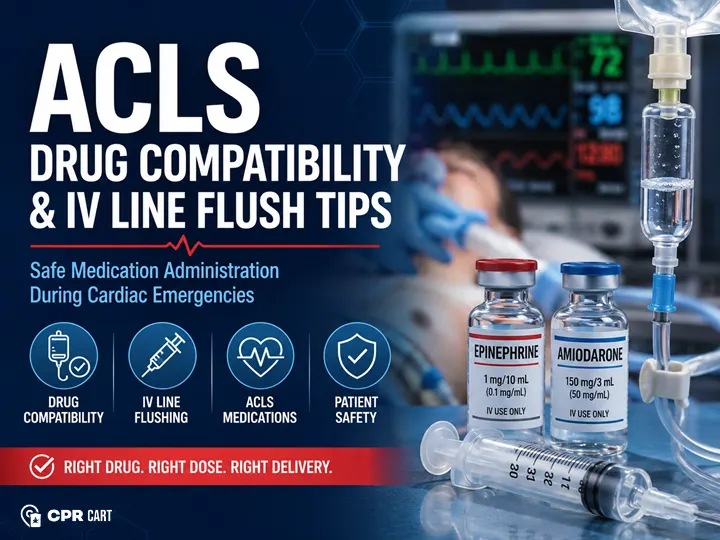
During a cardiac emergency, administering the correct medication is only one part of effective patient care. Healthcare providers must also ensure that medications are delivered safely and efficiently through intravenous (IV) or intraosseous (IO) access. Drug incompatibilities, inadequate flushing techniques, and vascular access issues can interfere with medication delivery during resuscitation.
In Advanced Cardiovascular Life Support (ACLS), medications such as epinephrine, amiodarone, lidocaine, and magnesium sulfate are often administered under significant time pressure. While ACLS algorithms help determine when these medications should be used, healthcare professionals must also understand how drug compatibility and IV line management influence medication effectiveness.
This guide explains the fundamentals of ACLS drug compatibility, the importance of IV line flushing, and best practices for medication administration during cardiovascular emergencies.
Related Reading: If you’re preparing for advanced cardiac emergency management, visit our ACLS Certification page. You may also find our guide on EtCO₂ Monitoring in ACLS: Waveform Capnography helpful for understanding real-time resuscitation monitoring.
Why Drug Compatibility Matters During ACLS
Medication administration during cardiac arrest or life-threatening arrhythmias often involves multiple drugs delivered through a limited number of vascular access sites. In many emergencies, providers may administer several medications through the same IV line within a short period.
Drug compatibility refers to whether medications can safely come into contact without causing physical or chemical reactions that may affect medication stability or delivery. While healthcare teams follow established protocols and pharmacy guidance when administering medications, understanding the basic concept of compatibility helps reduce the risk of medication administration issues during high-stress situations.
Compatibility considerations become even more important during cardiac arrest because circulation is already compromised. When every intervention is time-sensitive, providers must ensure medications reach the patient’s bloodstream as efficiently as possible.
Common Factors Affecting Drug Compatibility
Several factors can influence whether medications remain compatible within an IV line:
- Solution pH
- Medication concentration
- Type of diluent used
- Administration rate
- Temperature
- Contact time within IV tubing
Because compatibility information can vary among medications and formulations, providers should always follow current facility protocols and pharmacy recommendations.
Understanding Medication Delivery During Cardiac Arrest
Medication delivery during cardiac arrest differs from routine medication administration. Since the heart is not generating effective circulation, blood flow throughout the body becomes significantly reduced and depends largely on high-quality chest compressions.
As a result, medications administered through peripheral IV access may take longer to reach central circulation than they would under normal conditions. This is one reason why proper medication administration techniques remain an important part of successful resuscitation.
Healthcare providers should also recognize that the location of vascular access influences medication delivery. Peripheral IV access is often the fastest and most readily available option during emergencies. Central venous access provides more direct access to central circulation but may not always be available during the initial stages of resuscitation. When IV access cannot be obtained quickly, intraosseous (IO) access offers an effective alternative route for administering ACLS medications.
Understanding how medications travel through the circulatory system helps providers appreciate the importance of flushing techniques and line management during emergency care.
Common ACLS Medications and Administration Considerations
Several medications are commonly encountered during ACLS scenarios. Although medication selection is guided by established ACLS algorithms, providers should also be familiar with basic administration considerations.
| Medication | Common ACLS Use | Administration Considerations |
| Epinephrine | Cardiac arrest and selected bradycardia situations | Follow current protocols and ensure effective medication delivery |
| Amiodarone | Refractory ventricular fibrillation and pulseless ventricular tachycardia | Follow recommended preparation and administration guidance |
| Lidocaine | Alternative antiarrhythmic therapy | Monitor dosing and patient response |
| Magnesium Sulfate | Torsades de Pointes and certain electrolyte-related arrhythmias | Follow dilution and administration recommendations |
Regardless of the medication selected, providers should verify vascular access patency, communicate clearly with the resuscitation team, and document medication administration accurately.
Why IV Line Flushing Is Essential
One of the most important yet sometimes overlooked aspects of medication administration during resuscitation is IV line flushing.
After a medication is administered through an IV port, a portion of that medication may remain within the tubing. Without appropriate flushing, part of the intended dose may not immediately reach circulation. During cardiac arrest, where blood flow is already reduced, delayed medication delivery can further affect treatment efficiency.
Flushing helps move residual medication from the tubing into the bloodstream and promotes more complete medication delivery. It can also help clear the line before subsequent medications are administered.
In situations where multiple medications are delivered through the same access site, flushing may reduce the likelihood of residual medications remaining within the tubing between administrations. Healthcare providers should follow current ACLS recommendations and facility-specific protocols regarding flushing practices.
Signs of Potential Drug Incompatibility
While compatibility concerns are often identified through pharmacy guidance and established protocols, providers should be aware of visual signs that may indicate a problem within the IV line or medication solution.
Potential warning signs include:
- Cloudiness within the solution
- Visible precipitate formation
- Crystallization
- Unexpected color changes
- Separation of solution components
If incompatibility is suspected, providers should follow institutional procedures and seek pharmacy support when available.
Peripheral IV vs. Central Venous vs. IO Access
The route used for medication administration can influence delivery speed and overall effectiveness during resuscitation.
Peripheral IV Access
Peripheral IV access remains the most common form of vascular access during cardiac emergencies because it can be established quickly and allows immediate medication administration. It is often the first choice during initial resuscitation efforts.
Central Venous Access
Central venous access provides more direct access to central circulation and may be beneficial in critically ill patients who require ongoing medication infusions. However, obtaining central access may not be practical during the early stages of a cardiac arrest.
Intraosseous Access
When IV access cannot be established rapidly, IO access provides a reliable alternative route for medication administration. Most ACLS medications can be administered through an IO line, making it an important option during time-sensitive emergencies.
Regardless of the route selected, providers should continually assess line patency and ensure medications are being delivered effectively.
Preventing Medication Administration Errors During a Code
Medication administration errors during ACLS are often related to workflow challenges, communication issues, or vascular access problems rather than a lack of clinical knowledge.
To help reduce medication-related errors during resuscitation, healthcare teams should:
- Verify IV or IO patency before medication administration
- Follow established ACLS algorithms and facility protocols
- Communicate medication orders clearly
- Document medication administration accurately
- Monitor patient response to interventions
- Consider additional vascular access when clinically appropriate
Even small process improvements can enhance medication safety during high-pressure resuscitation events.
Best Practices for ACLS Medication Administration
Consistent medication administration practices can improve treatment efficiency and support patient safety.
| Best Practice | Clinical Benefit |
| Verify vascular access patency | Helps ensure medications reach circulation effectively |
| Flush medications according to protocol | Promotes complete medication delivery |
| Follow facility and pharmacy guidance | Supports medication safety |
| Use closed-loop communication | Reduces medication errors |
| Document administration times | Improves continuity of care |
| Monitor treatment response | Assists with ongoing clinical decision-making |
When these practices become routine, medication administration becomes more efficient and coordinated during emergency cardiovascular care.
Team Communication and Medication Safety
Successful resuscitation depends on effective teamwork. Medication administration requires coordination between the team leader, medication administrator, airway provider, compressor, and recorder.
Closed-loop communication remains one of the most effective strategies for reducing medication errors. When a medication order is given, the receiving provider repeats the order back to confirm understanding. After administration, the medication and administration time are communicated to the team.
This process improves situational awareness, helps prevent duplicate dosing, and ensures all providers remain informed about ongoing interventions. Strong communication skills are just as important as technical skills during a cardiac emergency.
Conclusion
Effective ACLS medication administration involves more than selecting the correct medication. Healthcare providers must also understand how medications move through vascular access systems, why compatibility considerations matter, and how proper flushing techniques support medication delivery during resuscitation.
By maintaining reliable vascular access, following compatibility guidance, flushing medications according to protocol, and communicating effectively within the resuscitation team, providers can improve the efficiency of medication administration during cardiovascular emergencies.
For additional ACLS education, explore our resources on waveform capnography, torsades de pointes management and other advanced cardiac emergency topics.
Frequently Asked Questions
What does drug compatibility mean in ACLS?
Drug compatibility refers to whether medications can safely come into contact within an IV line without causing reactions that may affect medication stability or delivery.
Why is flushing commonly performed after administering ACLS medications?
Flushing helps move residual medication from IV tubing into circulation and supports more complete medication delivery.
Can multiple ACLS medications be administered through the same IV line?
Yes. However, healthcare providers should follow compatibility guidance, facility protocols, and recommended flushing practices when administering multiple medications through the same line.
Is flushing important when using intraosseous access?
Yes. Proper flushing techniques help facilitate medication delivery through the IO route and into circulation.
What are common medication administration mistakes during a code?
Common issues include failure to verify line patency, communication breakdowns, documentation delays, and deviations from established medication administration protocols.
How can healthcare teams reduce medication errors during ACLS?
Teams can reduce errors by using closed-loop communication, verifying vascular access, following established protocols, documenting interventions accurately, and maintaining strong team coordination.