


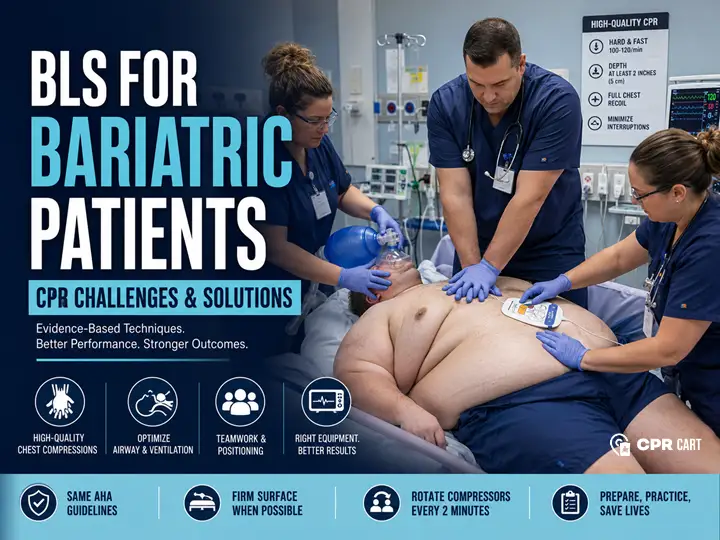
Cardiac arrest can occur in patients of any body size, but obesity introduces challenges that healthcare providers, first responders, and trained rescuers must overcome to deliver effective Basic Life Support (BLS). As obesity rates continue to increase worldwide, encounters with bariatric patients are becoming more common in hospitals, long-term care facilities, ambulances, and community settings.
The core principles of BLS remain unchanged: early recognition of cardiac arrest, immediate chest compressions, rapid defibrillation, and effective ventilation. However, applying these principles to a bariatric patient often requires adjustments in technique, positioning, equipment selection, and team coordination.
Understanding these challenges before an emergency occurs can significantly improve CPR quality, provider performance, and patient outcomes.
Quick Answer: Performing CPR on bariatric patients presents unique challenges because excess body tissue can make chest compressions, airway management, patient positioning, and rescuer ergonomics more difficult. Effective resuscitation requires high-quality CPR, proper hand placement, optimized airway positioning, adequate staffing, and specialized equipment when available.
What Is a Bariatric Patient?
A bariatric patient is generally defined as an individual whose body size, weight, or body habitus requires special healthcare considerations.
Clinically, many bariatric patients have:
- A Body Mass Index (BMI) of 40 kg/m² or greater
- A BMI of 35 kg/m² or greater with obesity-related medical conditions
- Excess adipose tissue that affects mobility, airway management, diagnostic procedures, or emergency interventions
From a resuscitation perspective, the primary concern is not simply body weight. Rather, it is how excess tissue affects access to the chest, airway, circulation, and overall CPR mechanics.
Why Is CPR More Difficult in Bariatric Patients?
CPR is more difficult in bariatric patients because excess body tissue can obscure anatomical landmarks, reduce chest wall compliance, complicate airway management, increase rescuer fatigue, and make patient movement more challenging. These factors can reduce CPR quality unless rescuers adapt their techniques appropriately.
Several anatomical, physiological, and logistical factors contribute to these challenges.
Anatomical Challenges
Excess adipose tissue over the chest, neck, abdomen, and upper airway can make standard BLS procedures more difficult.
Common challenges include:
- Difficulty locating chest compression landmarks
- Reduced visibility of anatomical structures
- Increased chest wall thickness
- Large breasts interfering with hand placement
- Difficult airway access
Physiological Challenges
Many bariatric patients have underlying conditions that increase the complexity of resuscitation.
These may include:
- Obstructive sleep apnea
- Obesity hypoventilation syndrome
- Hypertension
- Coronary artery disease
- Heart failure
- Type 2 diabetes
These conditions can contribute to rapid oxygen desaturation and increased cardiovascular instability during cardiac arrest.
Logistical Challenges
Practical obstacles often complicate bariatric resuscitations.
Examples include:
- Moving the patient to a firm surface
- Turning or repositioning the patient
- Transporting the patient safely
- Performing prolonged CPR
- Maintaining rescuer endurance
How Do You Perform CPR on an Obese Patient?
Perform CPR on a bariatric patient using standard BLS guidelines while ensuring proper chest compression location, full chest recoil, adequate depth, minimal interruptions, and effective airway management.
The American Heart Association does not recommend a separate CPR algorithm for obese patients. The goal remains high-quality CPR.
Chest Compression Challenges in Bariatric Patients
Finding the Correct Hand Position
One of the most common concerns is locating the proper compression site.
Despite increased body mass, rescuers should continue placing their hands on the lower half of the sternum, as recommended by current AHA guidelines.
If landmarks are difficult to identify:
- Locate the center of the chest visually.
- Identify the sternum between the nipples when possible.
- Avoid compressions over soft breast tissue.
- Reposition breast tissue if necessary to expose the sternum.
In female bariatric patients, large breasts may obscure anatomical landmarks. Rescuers may need to gently move tissue to ensure compressions are delivered directly over the sternum.
Does Compression Depth Change for Bariatric Patients?
No. Compression depth recommendations do not change for bariatric patients. Adult rescuers should compress at least 2 inches but not more than 2.4 inches according to current American Heart Association guidelines.
The Real Challenge
The challenge is achieving adequate compression depth through a thicker chest wall.
Research suggests that increased chest wall mass can reduce compression effectiveness if rescuers fail to generate sufficient force.
Rescuers should focus on:
- Compressing hard and fast
- Maintaining a rate of 100–120 compressions per minute
- Allowing full chest recoil
- Minimizing interruptions
Compression feedback devices can be especially helpful when available.
Rescuer Fatigue During Bariatric CPR
Providing effective compressions on a bariatric patient often requires greater physical effort than on an average-sized adult.
Signs of rescuer fatigue include:
- Reduced compression depth
- Slower compression rate
- Incomplete recoil
- Leaning on the chest between compressions
Solution
Rotate compressors every two minutes or sooner if compression quality begins to decline.
In clinical settings, teams should anticipate earlier fatigue and prepare additional personnel.
This recommendation aligns with principles taught in comprehensive BLS certification course.
Team Positioning During Bariatric CPR
Bariatric resuscitations often require more personnel and deliberate positioning to maintain CPR quality and provider safety.
Because increased chest wall mass frequently requires greater compression force, rescuers may fatigue sooner than during standard adult CPR.
Recommended Team Positioning
When possible:
- Position the compressor directly over the sternum.
- Use a step stool if needed to improve body mechanics.
- Assign a dedicated airway provider at the head of the patient.
- Designate additional personnel for patient movement and repositioning.
- Rotate compressors every two minutes or sooner.
- Use closed-loop communication during role changes.
Healthcare facilities that routinely care for bariatric patients should incorporate obesity-specific cardiac arrest scenarios into mock code training.
Airway Management Challenges in Bariatric Patients
Airway management is often the most difficult aspect of bariatric resuscitation.
Why Airway Management Is Harder
Excess tissue around the face, neck, and upper airway can cause:
- Airway obstruction
- Difficult mask seal
- Reduced ventilation effectiveness
- Difficult intubation
- Rapid oxygen desaturation
Many bariatric patients also have obstructive sleep apnea, increasing the likelihood of airway collapse during resuscitation.
How to Improve Ventilation During Bariatric CPR
Head Positioning
Proper positioning significantly improves airway patency in bariatric patients.
The preferred technique is the ramped position, which aligns the patient’s external auditory meatus (ear canal) horizontally with the sternal notch. This alignment helps open the upper airway, improves bag-mask ventilation, and facilitates advanced airway placement.
How to Create a Ramped Position
- Place folded blankets, pillows, or positioning devices beneath the upper back, shoulders, neck, and head.
- Elevate the torso and head until the ear canal and sternal notch align horizontally.
- Reassess alignment after moving the patient because soft tissue can shift.
In many bariatric patients, the ramped position provides superior ventilation compared with the traditional sniffing position.
Two-Person Bag-Mask Ventilation
Single-rescuer bag-mask ventilation frequently produces inadequate seals in obese patients.
A two-person technique is preferred because it:
- Improves mask seal
- Increases tidal volume delivery
- Reduces air leakage
- Improves oxygenation
For providers managing respiratory emergencies, understanding advanced airway considerations in BLS can improve preparedness.
Should Bariatric Patients Be Moved Before CPR?
No. CPR should begin immediately if the patient is unresponsive, pulseless, and not breathing normally.
Delaying chest compressions to reposition a patient can significantly reduce the chance of survival.
However, the patient should be moved onto a firm surface as quickly as practical.
Importance of a Firm Surface
Soft mattresses absorb compression force and reduce CPR effectiveness.
Solutions include:
- Moving the patient to the floor when feasible
- Using a CPR backboard
- Activating mattress CPR functions when available
- Utilizing hard support surfaces
In hospitals, many bariatric beds include CPR-release mechanisms designed to improve compression effectiveness.
What Equipment Is Needed for Bariatric CPR?
Bariatric CPR may require larger airway devices, reinforced stretchers, CPR backboards, bariatric transfer equipment, compression feedback devices, and specialized lifting systems.
Airway Equipment
- Oropharyngeal airways
- Nasopharyngeal airways
- Supraglottic airway devices
- Video laryngoscopes
- Larger masks for bag-mask ventilation
Patient Movement Equipment
- Bariatric transfer sheets
- Air-assisted transfer devices
- Bariatric stretchers
- Mechanical lifting systems
CPR Support Equipment
- CPR backboards
- Compression feedback devices
- Mechanical CPR systems when available
Can AEDs Be Used on Bariatric Patients?
Yes.
Automated External Defibrillators (AEDs) should be used according to standard BLS recommendations.
AED Pad Placement Considerations
Excess chest tissue can occasionally affect pad placement.
Providers should:
- Ensure pads make full contact with the skin
- Remove excessive chest hair if necessary
- Avoid placing pads over large skin folds
- Consider anterior-posterior placement if standard positioning is difficult
For detailed guidance, review this AED use guide.
Mechanical CPR Devices and Bariatric Patients
Mechanical compression devices can help maintain consistent CPR quality during prolonged resuscitations.
Potential advantages include:
- Reduced rescuer fatigue
- Consistent compression depth
- Improved CPR quality during transport
- Better performance during prolonged cardiac arrest events
However, bariatric body habitus may exceed device limitations.
Most mechanical CPR systems have manufacturer-specified limits related to:
- Chest width
- Chest circumference
- Weight capacity
- Anterior-posterior chest depth
Before deployment, providers should verify that the patient falls within approved dimensions and that the device can be applied without delaying manual CPR. If compatibility is uncertain, high-quality manual compressions should continue.
Special Considerations in Out-of-Hospital Bariatric Arrests
Prehospital providers often face additional challenges.
These include:
- Limited personnel
- Difficult extrication environments
- Narrow hallways and staircases
- Delayed transport
- Equipment weight limitations
Many EMS systems now use bariatric response protocols that include specialized lifting equipment and additional personnel.
Despite these obstacles, immediate high-quality CPR remains the intervention most strongly associated with survival.
Clinical Pearls for Bariatric CPR
- Use the same AHA compression depth and rate recommendations as for any adult patient.
- Place hands on the lower half of the sternum, even when landmarks are difficult to identify.
- Move breast tissue when necessary to ensure direct compression over the sternum.
- Maintain a compression depth of at least 2 inches (5 cm) while allowing full chest recoil.
- Use a firm compression surface whenever possible.
- Expect earlier rescuer fatigue and rotate compressors frequently.
- Use two-person bag-mask ventilation when personnel are available.
- Consider ramped positioning to improve airway patency and ventilation.
- Verify mechanical CPR device size compatibility before deployment.
- Do not delay chest compressions while attempting to reposition the patient.
Key Takeaways
Bariatric patients require the same evidence-based BLS interventions as all cardiac arrest victims, but delivering those interventions effectively often requires adjustments in technique, equipment, and team coordination.
Rescuers should focus on maintaining high-quality chest compressions, optimizing airway management through ramped positioning, ensuring a firm compression surface, using appropriate equipment, and anticipating increased physical demands. While obesity introduces significant challenges, adherence to AHA BLS principles remains the foundation of successful resuscitation.
Frequently Asked Questions
Do CPR guidelines change for obese patients?
No. Current American Heart Association guidelines use the same compression rate, depth, recoil, and AED recommendations for bariatric and non-bariatric adults. The difference lies in adapting techniques to overcome anatomical and logistical challenges while maintaining high-quality CPR.
Where should hands be placed during CPR on a bariatric patient?
Hands should be positioned on the lower half of the sternum, just as in standard adult CPR. If excess tissue obscures landmarks, rescuers should identify the center of the chest and ensure compressions are delivered directly over the sternum.
Is deeper CPR required for obese patients?
No. Recommended compression depth remains at least 2 inches (5 cm) but not more than 2.4 inches (6 cm). The challenge is achieving this depth consistently through a thicker chest wall while maintaining full recoil.
Why is airway management more difficult in bariatric patients?
Excess tissue around the neck and upper airway can increase airway obstruction and make mask ventilation more difficult. Bariatric patients also tend to desaturate more rapidly, making effective ventilation especially important.
What is the ramped position during bariatric CPR?
The ramped position elevates the patient’s upper body until the ear canal and sternal notch align horizontally. This positioning improves airway patency, facilitates ventilation, and can make advanced airway placement easier.
Can an AED work on a bariatric patient?
Yes. AEDs remain effective when pads are placed correctly and maintain good skin contact. If standard pad placement is difficult, anterior-posterior positioning may be considered according to manufacturer instructions.
Are mechanical CPR devices suitable for bariatric patients?
They can be, provided the patient’s body dimensions fall within manufacturer specifications. Providers should verify compatibility before use and continue manual CPR if the device cannot be safely applied.
Is bariatric CPR taught in BLS certification courses?
Most BLS courses discuss special resuscitation situations, but bariatric-specific training may vary. Providers who frequently encounter obese patients can benefit from advanced simulation training and continuing education focused on obesity-related resuscitation challenges.